Saturday 12th July - Sunday 20th July 2008
Progress Report
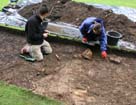
| 25th June | A large number of people have already applied to participate in the dig at Boarstall Tower during National Archaeology Week. |
| 11th July | The loos, mini digger and turf cutter arrived and, despite intermittent rain, by mid afternoon five trenches had been opened and the topsoil removed, ready for the dig the next day. |
| 12th July | Although clocking on time was 9.00am, many of the volunteers arrived some time
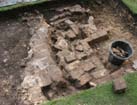
before and soon everyone had registered and was hard at work. Very soon footings became visible in trench 4 which is at the
back of the former house. Clearly these reflect several periods of building and it will take more time to reveal them fully
and to try and establish their history.
Good progress was made in all trenches and there were large quantities of finds, which will need cleaning and evaluation. Very few were later than the 17th century and they included strap handles from medieval Brill/Boarstall pottery, medieval floor tiles and a particularly interesting medieval coloured and glazed roofing ridge tile. It seems likely that at lower levels, even more interesting finds will be revealed. |
| 13th July |
Further progress has been made on all trenches but trench 4 has produced the most visible results. It seems that the footings are probably a kitchen open hearth fireplace, probably C17, that has been filled in with a C18 range, since removed. There is still quite a lot of rubble to remove. |
| 14th July |
Trench 4 has continued to keep the archaeologists guessing and, as they dig deeper, they have decided that they may have some way to go. |
| 15th July |
Trench 4 is now considerably deeper and the archaeologists reckon that they have reached the original medieval
floor. It looks as though there
is a medieval layer, then at a higher level a Tudor layer, then a 17th century layer and then, highest of all, a mid 18th
century layer.
This should finally be resolved tomorrow.
Footings have now been found in trench 1 and these appear to be the west wall of the original entrance porch on the front of the property. |
| 16th July |
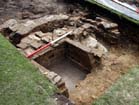
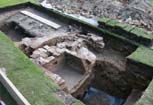
Trench 4 is now reasonably well resolved. The open hearth was in fact part of the remains of a bread oven and
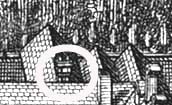
this morning part of a second bread oven was found to its right. These can be related to a chimney with two flues shown in
the 1695 print to rear of the range at the back of the right hand courtyard (see detail from this print above). The ovens
may date from the 17th century and one has been filled in with a smaller oven, probably cast iron, in the eighteenth
century, but since removed.
Late in the day, a small pit in Trench 3 revealed quantities of what appear to be 13th century Brill/Boarstall pot sherds. Nothing later was with or on top of these. It seems that there is a hard floor underneath which has yet to be investigated. A large quantity of rubble has been removed from Trench 2 to reveal a massive robber trench, from which all the stone, including the footings have been removed. It seems that the wall removed was very large as the footings appear to have been at least 4 feet wide. |
| 17th July |
A waste pit was discovered at the back of trench 4 and excavation started on this. In addition, some stones were
uncovered which seemed to be part of a structure and which will require further excavation.
Trench 3 revealed the footings from the N.E. corner of the house |
| 18th July |
Further excavation of trench 1 took place and, as a result, what may be a post hole has now been discovered.
This could be further evidence that the original house was timber framed.
The teams in trenches 1 - 4 started the detailed recording of their trenches. |
| 19th July |
Trench 5 produced an early iron key which might be late medieval or early Tudor.
In trench 3, a brick structure was discovered, apparently just outside the foundations of the house. |
| 20th July |
This was officially the last day of the dig.
Trench 5 revealed a second key, similar to the one found the day before, and then a fine complete, although broken, medieval floor tile was found, with an image of a bird. In addition, some stones that were clearly part of a structure were found at the edge of the trench. There was no time left to investigate this further. The possible post hole in trench 1 was excavated and was confirmed as a definite post hole, with stone at its base to support the post. This appears to line up with the N.W. corner of the medieval hall in the 1695 print and suggests that the hall was originally timber framed. When it was rebuilt or refaced in stone, it is quite possible that the original roof was retained. In trench 4, the stones mentioned on July 17th were further investigated and found to be part of the footings of an early wall that clearly predated the bread ovens and which was probably medieval. |
| 21st July |
One of the Trust's archaeologists arrived at 6.50am to do further recording and a volunteer was there to help him soon after 8.00am. |
The total number of finds trays was about 150.
The National Trust's involvement in National Archaeology Week at Boarstall has been most successful. From an archaeological viewpoint, the five trenches were very carefully sited based on the earlier geophysics and revealed much about the former Boarstall House. Of course many new questions were raised which were not answered because of the limited time available.
Trenches 1 - 4 each had a team of a least one experienced archaeologist and a small team of volunteer helpers for the whole week, whilst trench 5 had such a team for only 6 out of the nine days. Gary Marshall from the National Trust was in charge of the whole project and kept a detailed watch on the archaeology. His wife Anna, even though she had her four month old baby Evelyn with her, was, like Garry, at Boarstall about 11 hours each day, even including both weekends, allocating volunteers to particular tasks, organising the enormous quantities of finds and finding further volunteers to wash or clean the finds without losing their context. She also showed visitors round, explaining the site and the trenches yet somehow found time to make tea for all the helpers whilst finding experienced volunteers to look after the young children and get them involved in digging, doing geophysics, and learning about archaeology.
Other volunteers did a more detailed geophys survey of the site than had been done before, and others did a complete topographical survey of the site.
This was intended as a community project and many local people came to visit the site, often with their children. All were encouraged to join in. There were certainly new converts to archaeology, both adult and children.
What was most impressive was the depth of knowledge of the professional and experienced amateur archaeologists and the level of commitment, energy and application of everyone working on the site. The whole week had been well organised by Gary Marshall and the National Trust and he must be very pleased with the results.
A great deal of work remains to be done in identifying the thousands of finds and writing up the whole project.
A more detailed interim report should be posted on this site in a few weeks time.