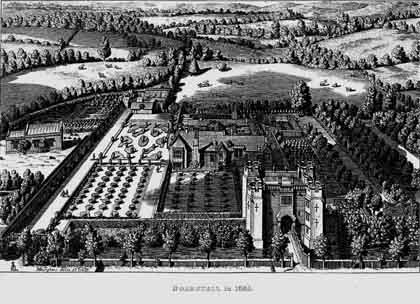
Boarstall is a parish and small village in the county of Buckinghamshire, England. It is about 2 ½ miles west of Brill, on the border with Oxfordshire, about 10 miles from the centre of Oxford.
Boarstall is not recorded in the Domesday Book (1086), and was presumably part of the manor of nearby Brill. However, a place of worship existed by 1141, so the village presumably existed by then.
There is a story that has been current for many hundreds of years that Boarstall acquired its name, and therefore existed, in Anglo-Saxon times, in the time of Edward the Confessor, but, if this event happened, the evidence suggests that it is more likely to have occurred nearer to, say, 1150, rather than, say, 1050. For further details, see Nigel the Forester and the Boarstall Horn. Boarstall was in, and became the administrative centre of, Bernwood Forest, used for hunting by both Anglo-Saxon and Norman kings.
In medieval times, Boarstall was a much larger community than it is today, with a thriving ceramics industry in assocation with nearby Brill. Examples of Brill/Boarstall pottery may be found at the Ashmolean Museum. Boarstall House, seen behind Boarstall Tower in the 1695 view above, was at the heart of the village, the main part of which, before it was demolished in 1645, was situated to the left of the field in the centre of the view above, and further left, across the road.
In the British civil war, Boarstall was the centre of heavy fighting, changing hands between the Royalists and the Parliamentarians three times. When the Royalists recaptured the village in 1645, to ensure that the Roundheads could not use it for cover, they demolished the whole village with the exception of Boarstall House (the manor house), its fortified gatehouse, now known as Boarstall Tower and the adjacent Elizabethan stable block and farmhouse (now Tower Farmhouse), which presumably was required for the garrison. All houses, the church and "all the trees, gardens, and other places of pleasure were cut downe and demolished". For further information about the Civil War, click on Boarstall in the Civil War.
Since only three buildings in the village were left standing, and one of those, Boarstall House, was demolished in 1778, there are only two buildings remaining in the village that predate the Civil War, the Tower and Tower Farm House.
Rebuilding of the village was a slow process. By 1697, some fifty years after the fighting in Boarstall, only seven new house had been built since the Civil War. The village has never grown back to its size before the Civil War, and at the time of writing, 2003, there are only fifty one dwellings in the village.